If you live anywhere near Lake Toho, Celebration, or the neighborhoods stretching out along US-192, you already know that Kissimmee glass does not stay clean for long. Between the pollen drifting off the surrounding groves, the humidity rolling in off the lakes, and the relentless Central Florida sun, windows and solar panels take a beating here in ways that homeowners in drier climates rarely deal with. Window and solar panel cleaning in Kissimmee, FL, is not just a cosmetic chore. It is maintenance that protects your view, your curb appeal, and in the case of solar arrays, your actual electric bill.
This guide walks through why Kissimmee’s environment is uniquely hard on glass and panels, what it actually costs to get them cleaned professionally, how to handle light cleaning yourself, and how to tell when it is time to call in a crew with the right equipment. Whether you are trying to fix streaky windows before a family visit or you noticed your solar production dipping this summer, you will find straight answers here.
Why Kissimmee’s Climate Is Rough on Windows and Solar Panels
Most cleaning advice you find online is written for a generic climate that does not really exist. Kissimmee has its own combination of stressors, and understanding them helps explain why “just wipe it down” advice rarely works here for long.
Hard water and mineral spotting. Central Florida’s municipal water carries a noticeable calcium and magnesium content. When that water lands on hot glass and evaporates in the sun, it leaves behind a chalky, etched residue instead of just drying clear. Over time, this mineral film bonds to the glass surface and becomes genuinely difficult to remove with a spray bottle and paper towel.
Pollen and organic buildup. Late winter through spring brings heavy oak and pine pollen across Osceola County, and it does not just sit on the surface. Combined with morning dew, pollen forms a sticky, slightly acidic film on glass and solar cells that hardens as the day heats up.
Humidity and biological growth. Kissimmee’s lake-adjacent humidity creates ideal conditions for algae and mold spores to take hold on north-facing windows, screens, and shaded panel edges, especially during the rainy summer months.
Construction dust and traffic film. With ongoing development around Kissimmee and the greater Orlando corridor, airborne construction dust and vehicle exhaust residue settle on exterior glass surfaces faster than in quieter rural areas.
I love bug season and insect residue. Twice a year, Central Florida’s infamous love bug swarms leave behind an acidic residue on glass and vehicle surfaces that, if left too long, can actually damage clear coats and window seals.
None of these on their own sound dramatic, but stacked together across a Florida summer, they explain why a window that looked fine in January can look genuinely dull by June, and why a solar array can lose meaningful output without the homeowner ever noticing a single dramatic event.
How Much Does Window Cleaning Cost in Kissimmee, FL?
This is one of the most common questions homeowners ask before booking any service, and vague answers do not help anyone plan a budget.
For a typical single-story Kissimmee home with standard-sized windows, professional exterior window cleaning generally falls somewhere in the range of $150 to $350 for the full job, depending on the number of panes, how much buildup has accumulated, and whether screens and tracks are included. Two-story homes usually run higher, often in the $250 to $500 range, because of the added time and equipment needed for safe, streak-free results at height. Interior window cleaning, when requested alongside exterior service, typically adds a modest amount per window rather than doubling the price, since interior glass usually has far less buildup than exterior glass exposed to weather.
A few factors that move the price up or down:
- Total number of windows and panes, including French-style multi-pane windows that take longer per unit
- How long it has been since the last cleaning
- Whether hard water staining requires additional treatment beyond a standard wash
- Screen removal, washing, and reinstallation
- Track and sill detailing, which removes trapped dirt, dead insects, and pollen buildup
- Access difficulty, such as second-story windows over landscaping or pool enclosures
The honest answer is that anyone quoting a firm number without seeing your home or asking a few questions is guessing. A legitimate local provider will walk through these factors with you and provide a clear, line-item estimate rather than a vague ballpark, which is worth insisting on before you book.
How Much Does Solar Panel Cleaning Cost in Kissimmee, FL?
Solar panel cleaning pricing depends heavily on system size, roof pitch, and accessibility rather than following a flat per-panel rate everywhere. For a typical residential system in the Kissimmee area, homeowners can generally expect to pay somewhere in the $150 to $400 range for a full cleaning, with larger commercial arrays priced separately based on panel count and roof configuration.
What actually drives that number:
- Number of panels and total roof square footage covered
- Roof pitch and how safely technicians can access the array
- Level of buildup, since panels that have not been cleaned in over a year often require more thorough treatment
- Whether the array includes ground-mounted panels, which are more accessible but still require careful handling
Regular cleaning, roughly once or twice a year for most Kissimmee homes, tends to cost less over time than letting buildup accumulate for several years and then needing a more intensive first cleaning to reverse it.
Does Dirty Glass Actually Hurt Solar Panel Performance?
Yes, and the math is more significant than most homeowners assume. Solar panels generate electricity based on how much direct sunlight reaches the photovoltaic cells beneath the glass surface. A layer of pollen, dust, or bird droppings does not just look unattractive; it physically blocks a portion of that sunlight from reaching the cells.
Industry research on solar output generally shows that moderately soiled panels can lose somewhere between 5 and 20 percent of their expected output, with heavily neglected panels in high-pollen or high-dust regions sometimes losing even more. In a state like Florida, where solar adoption has grown rapidly and homeowners are counting on those panels to offset real utility costs, a 10 percent efficiency loss across a full summer billing cycle is not a small number. It shows up directly on the electric bill.
Uneven buildup causes a second, less obvious problem: partial shading. When grime accumulates unevenly across a panel, especially bird droppings or leaf debris concentrated in one spot, it can create localized shading that drags down the output of the entire connected string of panels, not just the one dirty cell. This is one of the main reasons solar installers recommend regular cleaning as routine maintenance rather than an optional cosmetic extra.
What Is the Best Window Cleaner for Streak-Free Glass?
This question comes up constantly, and the honest answer depends on what is actually on your glass.
For everyday light dust and fingerprints, a simple solution of distilled water with a small amount of dish soap, applied with a microfiber cloth, handles the job fine. The key detail most people miss is using distilled or deionized water rather than straight tap water, especially in a hard water area like Kissimmee. Tap water reintroduces the exact mineral spotting you are trying to remove, which is why store-bought glass cleaners sometimes leave faint streaks even when used correctly.
For genuinely stubborn buildup, including hard water spots, pollen film, or love bug residue, a solution of equal parts white vinegar and warm distilled water cuts through mineral deposits more effectively than most commercial sprays, without leaving behind ammonia residue that attracts dust. Rubbing alcohol works well for a final streak-free pass on smaller areas.
What generally does not work as well as marketed:
- Paper towels, which leave lint and micro-scratches over repeated use
- Newspaper, the classic old tip, which can transfer ink onto light-colored frames
- Heavily ammoniated commercial cleaners on tinted or coated glass, which can degrade certain window films over time
If you are choosing a single product to keep on hand, a basic vinegar and distilled water mix in a spray bottle, paired with a quality microfiber cloth or squeegee, outperforms most name-brand glass cleaners for the price, particularly in a mineral-heavy water area like ours.
How to Make Window Cleaner at Home
For homeowners who want to handle light, routine cleaning between professional visits, a simple DIY solution is easy to mix and genuinely effective on everyday grime.
Basic streak-free window cleaner:
- 2 cups distilled water
- 1/2 cup white vinegar
- 1 to 2 drops of dish soap (optional, for extra-greasy spots like handprints on entry doors)
Combine the ingredients in a spray bottle and shake gently before each use. Spray a light, even coat on the glass, then wipe with a microfiber cloth using horizontal strokes on one side of the pane and vertical strokes on the other. This trick makes it easy to tell which side any remaining streak is on. Finish with a dry microfiber cloth or a rubber squeegee for a fully streak-free result.
For hard water spots specifically, let the vinegar solution sit on the affected area for several minutes before wiping, rather than wiping immediately. This gives the acidity time to break down the mineral bond instead of just smearing it around.
A few practical notes for Florida conditions: avoid cleaning windows in direct, blazing midday sun, since the solution evaporates before you can wipe it away and leaves streaks behind. Early morning or late afternoon works far better here. Also avoid this DIY approach entirely on tinted windows, low-E coated glass, or any surface under manufacturer warranty language that restricts cleaning products, since vinegar’s acidity can interact poorly with certain specialty coatings over repeated use.
DIY vs. Professional Cleaning: Where to Draw the Line
DIY solutions genuinely work well for single-story, easily reached windows with light, routine buildup. Where DIY starts to fall short in Kissimmee specifically comes down to three things.
Height and access. Second-story windows, windows over pool enclosures or landscaping beds, and anything near a screen enclosure roofline are not worth the fall risk for most homeowners. Professional crews use water-fed pole systems specifically designed to reach these areas safely from the ground.
Solar panels. This is not an area for casual DIY experimentation. Walking directly on a roof to clean panels risks both personal injury and physical damage to the panels themselves, including scratched anti-reflective coatings or cracked cells from pressure applied in the wrong spot. Improper cleaning can also void manufacturer warranties, which typically specify approved cleaning methods.
Deep, bonded buildup. Once hard water mineral deposits have baked into glass over multiple seasons, or algae has established itself in shaded corners, a spray bottle and cloth generally cannot fully reverse it. This is where deionized water systems and professional-grade equipment make a measurable difference, lifting bonded contaminants rather than just smearing them.
A reasonable approach for most Kissimmee homeowners is light DIY maintenance on easily accessible ground-floor glass between professional visits, with a licensed, insured crew handling anything above ground level, anything involving the solar array, or an annual deep clean to reset everything to a genuinely clean baseline.
What to Expect from a Professional Visit
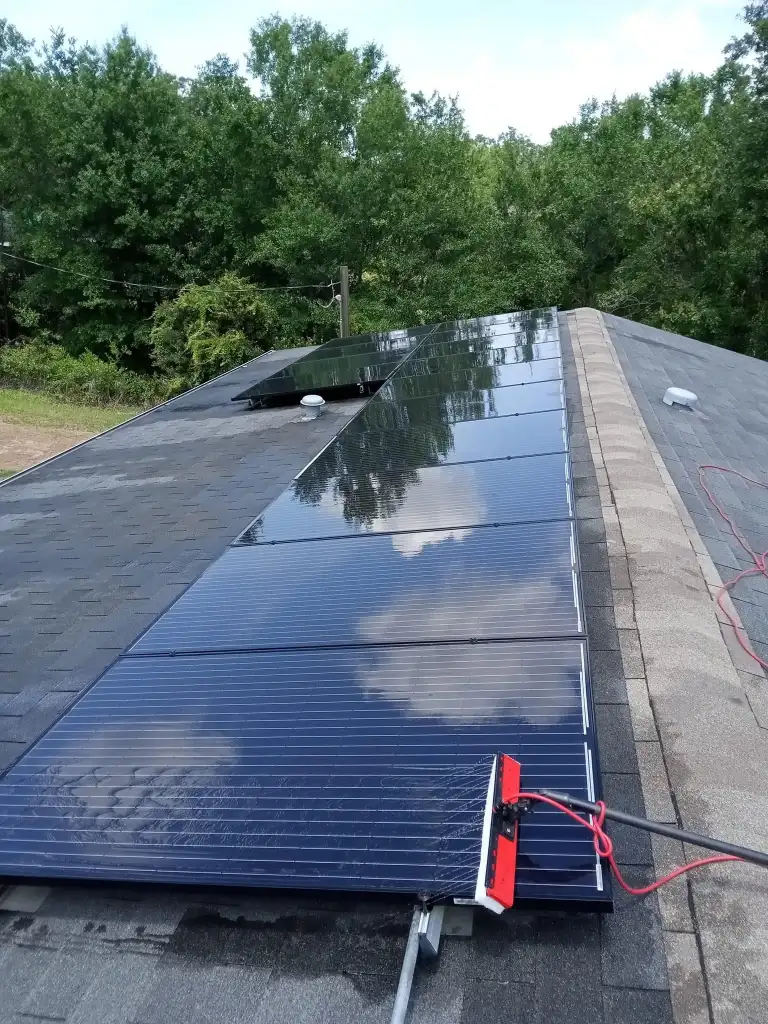
A properly run window and solar panel cleaning appointment in Kissimmee should follow a clear, predictable process rather than feel like a mystery. Technicians typically start with an assessment of the property, checking window count, access points, screen condition, and solar array layout before beginning work. For windows, this usually includes glass cleaning on both accessible interior and exterior surfaces, track and sill detailing to remove trapped debris, and screen removal and washing when needed. For solar arrays, technicians should use soft, non-abrasive tools and purified water systems specifically because standard tap water and stiff brushes risk scratching the glass coating that protects each cell.
Before booking, it is worth confirming that a provider carries proper state licensing and commercial liability insurance, since that protects your property in the unlikely event of an accident. It is also reasonable to ask how runoff is managed near landscaping, pool areas, and any electrical components, since responsible providers take steps to keep water and any cleaning agents away from sensitive areas.
Preparing Your Home for Window and Solar Panel Cleaning
A little preparation makes any visit faster and smoother. Before your scheduled appointment, consider the following.
- Clear window sills and ledges of decorative items, plants, or small furniture
- Secure pets indoors or in a separate area during the visit
- Unlock any gates needed for backyard or side access
- Move vehicles away from the driveway if solar panel equipment needs to be staged nearby
- Note any specific problem areas, such as a chronically streaky window or a shaded panel section, so technicians can pay extra attention there
None of this takes more than a few minutes, but it means the crew can move efficiently through the property without unnecessary interruptions, which keeps the visit on schedule.
How Often Should You Clean Windows and Solar Panels in Kissimmee?
Given everything covered above, most Kissimmee homes benefit from professional window cleaning roughly twice a year, typically after peak pollen season in spring and again before the holiday season in late fall, with light DIY touch-ups in between as needed. Solar panels generally hold up well with cleaning once or twice annually, though homes near heavy tree cover, agricultural land, or with unusually low panel tilt angles that trap more debris may benefit from a slightly more frequent schedule.
The right frequency really comes down to your specific property’s exposure. A home tucked under mature oak trees will need more frequent attention than one with a clear, open roofline, and a system installer or local service provider familiar with your neighborhood’s conditions can help fine-tune that schedule based on what they actually see during the first visit.
Conclusion
Clean windows and efficient solar panels are not separate projects competing for your attention; they are two sides of the same maintenance habit that protects both the look and the performance of your home. Kissimmee’s climate, from hard water and pollen to humidity and love bug season, makes this maintenance more necessary here than in many other parts of the country, but it also means the payoff, in curb appeal and in actual energy savings, is more noticeable when you stay on top of it.
Whether you tackle light cleaning yourself with a simple vinegar and distilled water solution or bring in a licensed local crew for the harder-to-reach glass and the solar array, the goal is the same: a home that looks as good as it performs.
FAQ’s
How much does window cleaning cost?
Professional window cleaning in Kissimmee typically runs $150 to $350 for a single-story home, and $250 to $500 for two-story homes, depending on window count, buildup level, and whether screens and tracks are included. Always ask for a line-item estimate.
How to make window cleaner?
Mix 2 cups distilled water, 1/2 cup white vinegar, and a drop of dish soap in a spray bottle. Apply to glass, wipe with a microfiber cloth, and finish with a squeegee. Avoid midday sun so the solution does not evaporate before wiping.
What is the best window cleaner?
For Kissimmee’s hard water, a distilled water and white vinegar solution outperforms most commercial sprays because it avoids reintroducing mineral spots. Use a microfiber cloth or squeegee rather than paper towels for a true streak-free finish.
How much does solar panel cleaning cost in Kissimmee?
Residential solar panel cleaning generally costs $150 to $400 depending on system size, roof pitch, and buildup level. Larger commercial arrays are priced separately based on panel count and access requirements.
How often should solar panels be cleaned?
Most Kissimmee homes benefit from professional solar panel cleaning once or twice a year. Homes near heavy tree cover or agricultural dust may need more frequent cleaning to avoid measurable energy output loss.
Can dirty windows or panels really affect my energy bill?
Yes. Soiled solar panels can lose an estimated 5 to 20 percent of their expected output, which directly reduces energy savings. Windows do not affect energy the same way but do impact natural light and curb appeal.